

The First Part of Training That Puts You In a Jet (kind of)
Up until this point in your pilot training you will have done everything in piston-engined propellor aircraft. This next part of your training is where you get your first experience of handling a jet! You actually have options about which course to choose – you don’t do all three (more on that as we go on). But right from the start, let’s do some jargon-busting:
JOC
Jet Orientation Course
MCC
Multi-Crew Co-operation
APS
Airline Pilot Standard
As the above definitions suggest, this part of a pilot’s training is designed around becoming prepared to operate a jet, in a multi-crew environment, to an airline-standard. And there’s actually a really good reason for needing a course around this type of flying: up until this point in a pilot’s training they’ve only ever flown piston-engined propellor aircraft that are designed to be operated by a single pilot. There is a significant difference between a student being ready to pass the CPL MEIR flight tests and being airline-ready, and that’s where these courses fit in. All of these courses are designed to fit in the gap between becoming a Commercial Pilot in piston-powered aircraft, and beginning a Type Rating with an employer.
At this point in a pilot’s training, you actually have a choice about which level of course you want to take. The JOC is the most basic course, the MCC is a step up, and the APS is the current top-level course available. Which variety of course you choose to do is entirely up to you, and I’ll do my best to outline where each course came from as well as their respective pro’s and con’s below.
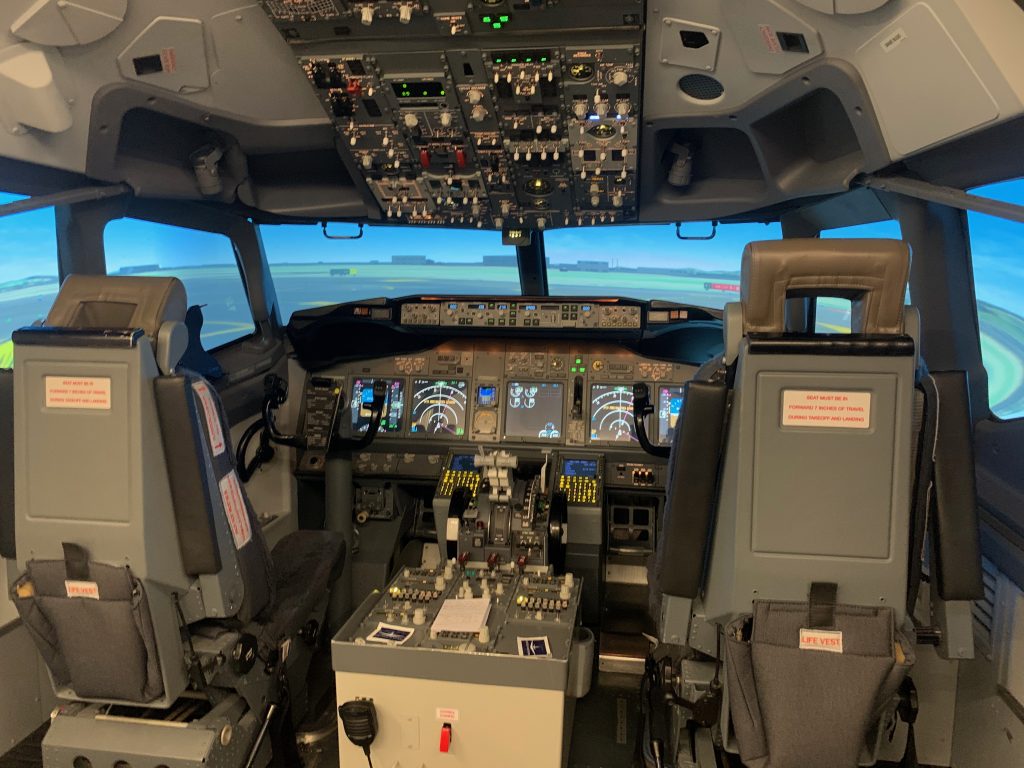
Each of the courses will offer an amount of theoretical training and time in a jet simulator – the amount of each varying depending on the course and training provider. The type of simulator used varies too, with some providers using generic jet simulators while others use type-specific simulators, such as the Boeing 737NG and Airbus A320. Most courses are offered in fixed-base simulators, though some do offer the course in full motion simulators. Also note – many airline simulator assessments take place in a B737NG simulator, even if the B737 is not part of their fleet.
Opinion Time: Full motion simulators are nice, but absolutely not a requirement - and are likely to increase the cost of a course. If you can find a competitively-priced course in a full motion simulator, great, but otherwise Full Motion is an unnecessary luxury.
Jet Orientation Course (JOC)
The Jet Orientation Course is designed to teach new Commercial Pilots the basics of handling a jet-powered aircraft. Believe it or not, a jet handles significantly differently to a piston-engined aircraft. The JOC, as the name suggests, is designed to give pilots an orientation and overview of the handling characteristics of a jet-powered aircraft.
It’s becoming less common for a student to take a standalone Jet Orientation Course, instead it’s often taken alongside an MCC course, or taken as a component within the APS, but it is still possible to take a JOC on its own. There are a number of providers (some highlights at the bottom of the page), and all offer students some theoretical teaching in a classroom and time in a jet simulator. Standalone Jet Orientation Courses vary in length and the amount hours flown in the simulator, but generally take place over a few days to a week and give students 10-15 hours of simulator time.
Multi-Crew Co-operation (MCC)
The Multi-Crew Co-operation course, as the name suggests, is all about working as part of a multi-person crew on the flight deck. One of the factors behind the development of the was the crash of Air France 447, where the flight crew were operating in conflict with each other without realising. Clearly when working in a commercial context, it’s just as important for a flight crew to be able to work together effectively as it is for them to be able to technically operate their aircraft.
EASA have actually outlined their requirements for an approved MCC course as having a minimum of 25 hours of theoretical training and 20 hours of simulator time (or 15 hours for students on an Integrated course). More of the EASA regs can be found at FCL.735.A.
Given the amount of time required to be undertaken in a simulator, the MCC is often combined with a Jet Orientation Course.
Be aware of branding though: Some courses are advertised as being an “MCC/JOC”, while other courses called an “MCC” will have the JOC within it without specifically saying so!
The MCC (or MCC/JOC) adds a Human Factors element to the theoretical teaching and in the simulator puts more of a focus on cockpit teamwork and cohesion.
MCC (or MCC/JOC) courses are longer than a standalone JOC thanks to the extra material to cover, and tend to last around a week to 10 days.
Airline Pilot Standard (APS/MCC)
The APS/MCC is sometimes referred to as a mini-Type Rating, as it goes into even more depth than the MCC/JOC. Incidentally – while the APS/MCC courses don’t often have the “JOC” portion of the course in their name, they do all include the JOC content. The APS adds three main factors to the MCC:
- Advanced swept-wing jet training
- Advanced airline operations scenario training
- A final assessment.
In practice, the APS/MCC is often closely based around airline-specific Standard Operating Procedures. Ryanair were the main proponent of the APS/MCC’s development and have a number of “Approved” APS/MCC training providers, making their training more Ryanair-specific, and giving pilots a higher chance of success should they apply for a job at Ryanair. Ryanair refer to other APS/MCC training providers that are not Ryanair-approved as “White Tail”. Here’s a snapshot of how Ryanair say their interview candidates do, based which type of APS (or MCC) they did, taken from from this Pilot Careers News interview.
Successful Ryanair interview candidates, Jan 2021 – Oct 2021:
| Candidates who completed a Mentored APS MCC: | 97.5% |
| Candidates who completed a Whitetail APS MCC: | 70% |
| Candidates who held an MCC/JOC: | 61% |
| Candidates who held an MCC: | 48% |
Other airlines are fans of the APS/MCC too, though Ryanair are the course’s biggest advocates.
In addition to the final assessment, many training organisations will incorporate performance-based grading into each session, just like a pilot would receive when going through a Type Rating. As a result, the APS/MCC course is the only one a pilot can fail if they do not perform well enough.
Class room based theoretical training for an APS lasts longer than for an MCC/JOC, and because of the additional training requirements of an APS, the course requires an additional 20 hours of simulator time – making an APS course a minimum of 40 hours (or 35 for Integrated students).
At the time of writing, the APS/MCC is the highest level of course available and gives pilots the deepest level of training into airline operations and procedures.
Pilot Flying (PF) & Pilot Monitoring (PM)
It’s also worth noting that most courses (certainly MCC/JOC and APS/MCC) are carried out with another student as a sim partner. This means that simulator time is split 50/50 between being “Pilot Flying” and “Pilot Monitoring”. Most pilots will not have encountered these terms in relation to their own flying before this point, so can at first be confusing.
The Pilot Flying refers to the member of the flight crew who is in direct control of the aircraft’s flight trajectory whether through manual input or control of the automation.
The Pilot Flying has one job: fly the aircraft, and not worry about any other distraction.
The Pilot Monitoring will be responsible for monitoring the actions of the Pilot Flying, and be responsible for communication with Air Traffic Control and the cabin crew team (which will all of course be simulated in these courses).
The Pilot Monitoring has one job: intercept anything that could possibly distract the Pilot Flying from doing their job.
For the purposes of these courses, the Pilot Flying will tend to be the pilot in the right-hand (co-pilot) seat, while the Pilot Monitoring will tend to be the pilot in the left-hand (captain) seat. This is primarily because pilots going through these courses will be applying for First Officer or Second Officer roles, who will be sat in the right-hand seat. The PM/PF roles can and do occasionally change through the course of a lesson, but this is the general trend. To that end, of a 40-hour APS course, 20-hours will be spent as Pilot Flying and 20-hours will be spent as Pilot Monitoring.
Both of these roles are absolutely critical, and Pilot Monitoring must not be thought of as a chance to rest while the other student acts as Pilot Flying. In many of my APS sim sessions the Pilot Monitoring had a considerably higher workload than the Pilot Flying.
Here are some really well known and respected providers of the above courses:
Where I Went
Simtech Aviation
Based in Dublin, Ireland, Simtech offers a range of courses using a state of the art suite of simulators, based in their cutting edge headquarters close to Dublin Airport.